
VNG
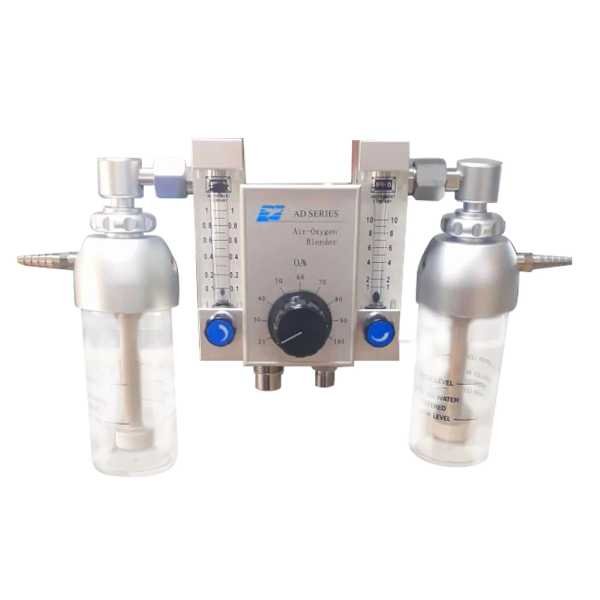
VNG Air Oxygen Blender
Contact our team for pricing, configuration options and availability.
Thanks! Our team will contact you shortly.
Precision air-oxygen blender for delivering an accurate, adjustable oxygen concentration during respiratory support.
21–100% FiO2 dial, dual outlet ports with check valves, and an audible low-pressure/low-supply alarm. By VNG Medical.
At a glance
- Precise 21–100% FiO2 concentration dial
- Available in High Flow (2–100 L/min) and Low Flow (0–30 L/min) models
- Primary and auxiliary outlet ports with check valves
- Audible alarm for excessive pressure drop or gas depletion
- Optional 3-outlet manifold for multi-patient/multi-device setups
OVERVIEW
The VNG Air Oxygen Blender lets clinicians dial in a precise oxygen concentration, between 21% and 100%, for infant respiratory support — used with devices such as CPAP systems, resuscitators and oxygen hoods. It is available in High Flow (2–100 L/min) and Low Flow (0–30 L/min) models.
FEATURES
- Oxygen concentration dial, 21%–100%
- Primary outlet port with male DISS oxygen fitting and check valve
- Auxiliary outlet port with male DISS oxygen fitting, check valve and bleed valve
- Auxiliary bleed collar for controlling bleed engagement/disengagement
- Oxygen inlet fitting (female DISS or NIST) with a one-way valve
- Audible alarm for excessive pressure drop or gas supply depletion
- Optional manifold outlet with 3 primary outlets
SPECIFICATIONS
- Oxygen concentration range: 21%–100%
- High Flow model: 2–100 L/min
- Low Flow model: 0–30 L/min
- Bleed engagement recommended for accurate FiO2 below 15 L/min (High Flow) or ≤3 L/min (Low Flow)
Frequently asked questions
What is an air-oxygen blender used for?
It mixes medical air and oxygen to deliver a precise, adjustable oxygen concentration (FiO2) for respiratory support devices such as CPAP systems, resuscitators and oxygen hoods.
What's the FiO2 range?
21% to 100%, selected via the concentration dial.
What's the difference between the High Flow and Low Flow models?
High Flow delivers 2–100 L/min; Low Flow delivers 0–30 L/min. Choose based on the flow rate your respiratory device requires.
Does it warn if gas supply runs low?
Yes — it has an audible alarm for excessive pressure drop or gas supply depletion.
Can it feed more than one device at once?
An optional manifold outlet with 3 primary outlets is available for multi-device setups.
Related products
Related reading
Anesthesia
Understanding the Role of Anesthesia in Pediatric Surgery: Best Practices and Equipment
This article delves into pediatric anesthesia's critical role in surgery, emphasizing best practices and the necessary equipment to ensure safety in NICU settings.
Read article Liver/HepatologyThe Role of Diagnostic Equipment in Early Detection of Pediatric Liver Conditions
This article explores the critical role of diagnostic equipment in the early detection of pediatric liver conditions, emphasizing its impact on patient care.
Read article